Michaelangelo’s Ghost
Book 4 of the Jaya Jones Treasure Hunt Mysteries

A lost work of art linking India to the Italian Renaissance, a killer hiding behind a centuries-old ghost story, and a hidden treasure in Italy’s macabre sculpture garden known as the Park of Monsters, lead Jaya and her brother to the heart of Italy.
Filled with the unexpected twists, vivid historical details, and cross-cultural connections Pandian is known for, Michelangelo’s Ghost is the most fast-paced and spellbinding Jaya Jones novel to date.
When Jaya’s old professor dies under eerie circumstances shortly after discovering manuscripts that point to a treasure in Italy’s Park of Monsters, Jaya and her brother pick up the trail. From San Francisco to the heart of Italy, Jaya is haunted by a ghost story inexorably linked to the masterpieces of a long-dead artist and the deeds of a modern-day murderer. Untrustworthy colleagues, disappearing boyfriends, and old enemies—who can Jaya trust when the ghost wails?
Audible | Amazon | Barnes & Noble | Apple | Kobo | Bookshop | Waterstone’s | Blackwell’s
Praise for Michelangelo’s Ghost
Named a “Best of 2016” cozy mystery by Suspense Magazine, and short-listed for both the Lefty Award for Best Mystery of 2016 and the Silver Falchion Award.
“Everything a mystery lover could ask for: ghostly presences, Italian aristocrats, jewel thieves, failed actors, sitar players, and magic tricks, not to mention dabs of authentic history and academic skullduggery.”
—Publishers Weekly











Author’s Note from Michelangelo’s Ghost
The modern-day characters in Michelangelo’s Ghost are fictional, but the historical figures aside from the Allegri family are real, as is the Park of Monsters.
The Park of Monsters is a Renaissance sculpture garden in Italy that exists as I describe it. It’s off the beaten path, but it’s worth a day trip if you find yourself traveling to Rome or Florence. The surrounding area is similar to what I describe in the book, but I changed the names and details of the villa, restaurants, and wineries.
Pier Francesco “Vicino” Orsini is the true historical figure who conceived of the macabre park, but scholars disagree about his motives. Many historical “facts” contradict each other, but the history Jaya unearths is as accurate as history has recorded—except for Vicino’s friendship with the fictional character of Lazzaro Allegri. Lazzaro and his Allegri relatives, including the ghosts, are fictional.
Michelangelo is, of course, real. And yes, there is a theory asserting it was Michelangelo, not Pirro Ligorio, who was the true architect of the Park of Monsters. Is it possible this is true? The dates fit, as does the location. Michelangelo spent time at a nearby marble quarry. However, it’s unlikely there wouldn’t be more historical evidence if it were the case (and unlikely that Michelangelo wouldn’t have taken credit for it). Yet at the same time, the more historical research I undertake for my novels, the more I’ve come to realize that history is far more complicated than what’s presented in school textbooks.
One of the aspects of history that fascinates me most is the world travel that happened long before travel became as easy as it is today. Explorers, missionaries, traders, artists, servants, and slaves have visited and learned from other cultures for millennia. Some of that history has been recorded, but much of it is still being pieced together. There’s not much recorded history about what Indian and European artists learned from each other during the Renaissance, but with the other ideas being shared between those cultures at the time, why not art? Bahadur Shah of Gujarat was a patron of the arts before he was killed by the Portuguese.
The rediscovery of the Park of Monsters is nearly as fascinating as the park itself. The park was opened to the public in 1552, but after Vicino Orsini’s death in 1585 his labyrinthine sculpture garden fell into disrepair. Before visiting, I couldn’t imagine how that had happened, but after seeing the feral forest surrounding it I came to understand how nature could easily take over. It wasn’t until a century ago that people again stumbled upon it and thought it worthwhile to clear away centuries of overgrowth. Salvador Dalí was one of the people involved in doing so, and the otherworldly sculpture garden has inspired many artists, poets, and filmmakers. In 1954, four hundred years after it first opened, the park was bought by Giovanni Bettini and restored for the public.
I don’t want to say too much about the solution of the mystery at the Park of Monsters in Michelangelo’s Ghost, in case you’re reading this note before finishing the book, but I can say this: The details of the explanation are historically accurate.
Like the treasures in my other novels, this one is fictional but based in very real history, making it possible that something quite similar is out there, waiting to be found…
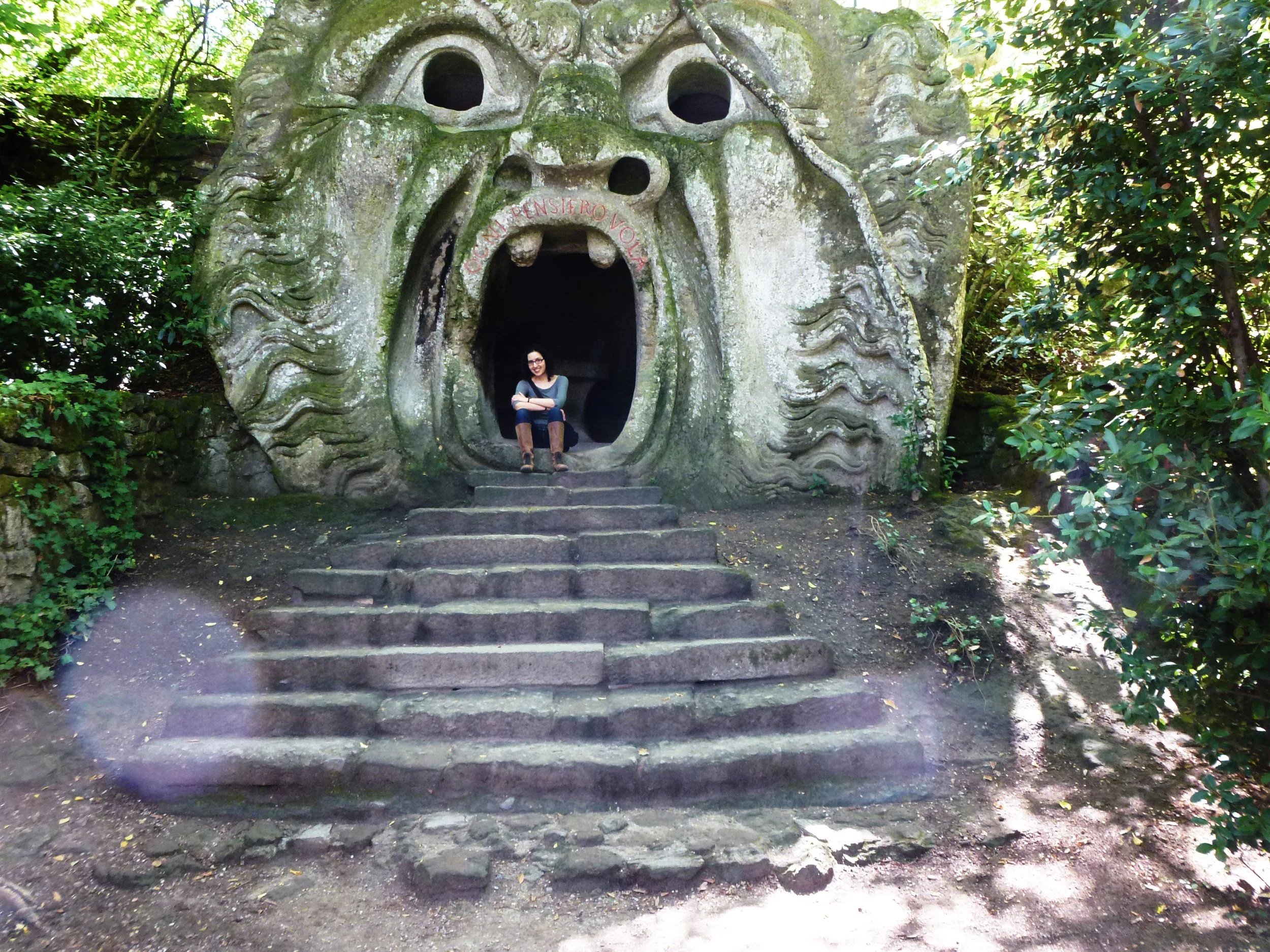
Gigi Pandian visiting the Park of Monsters, the inspiration for Michelangelo’s Ghost, in 2015.