



Wake Up Dead Man, the new Knives Out movie from Rian Johnson, is an exceptional mystery on many levels. Lots has been written about the film elsewhere, so I’ll focus this post on my favorite element of the movie: It’s a locked-room mystery that pays homage to John Dickson Carr, one of my favorite authors of all time.
Novelist John Dickson Carr (1906-1977) was the master of the locked-room mystery, the type of mystery where it appears truly impossible for the crime to have been committed.
One of the reasons Carr’s impossible crime novels are still powerful today is because he did much more than create clever puzzles. He brought stories vividly to life by creating gothic backdrops that suggested supernatural entities were pulling the strings—before revealing a rational solution.
And that’s exactly what happens in Wake Up Dead Man. The stage is set with an eerie atmosphere that looks supernatural, but the film ends with an incredibly satisfying logical explanation.
The hero of the movie is Father Jud (played by Josh O’Connor), a good man trying to do the right thing, which causes him to clash with his parish’s demagogue, Monsignor Wicks (Josh Brolin). When Wicks is murdered under seemingly impossible circumstances, and then appears to rise from the grave, Father Jud is at the center of both events. But Knives Out series detective Benoit Blanc (Daniel Craig) doesn’t believe all is as it appears, and is determined to clear Father Jud from suspicion.
Rian Johnson has widely talked about his love of Golden Age mysteries, and of John Dickson Carr specifically. He even wrote the introduction to a new edition of Carr’s The Problem of the Wire Cage, reissued in 2024 (you can read an excerpt of that introduction here, courtesy of Crimereads).
Wake Up Dead Man is a mystery with two impossible crimes. First, an impossible murder in a small room of a church while a closed circle of characters are nearby, but none of them close enough to commit the crime. Second, the dead man walks out of the crypt in which he was entombed. Both crimes are ingeniously set up, and screenwriter and director Rian Johnson sets out to solve the crimes much as John Dickson Carr would have done.
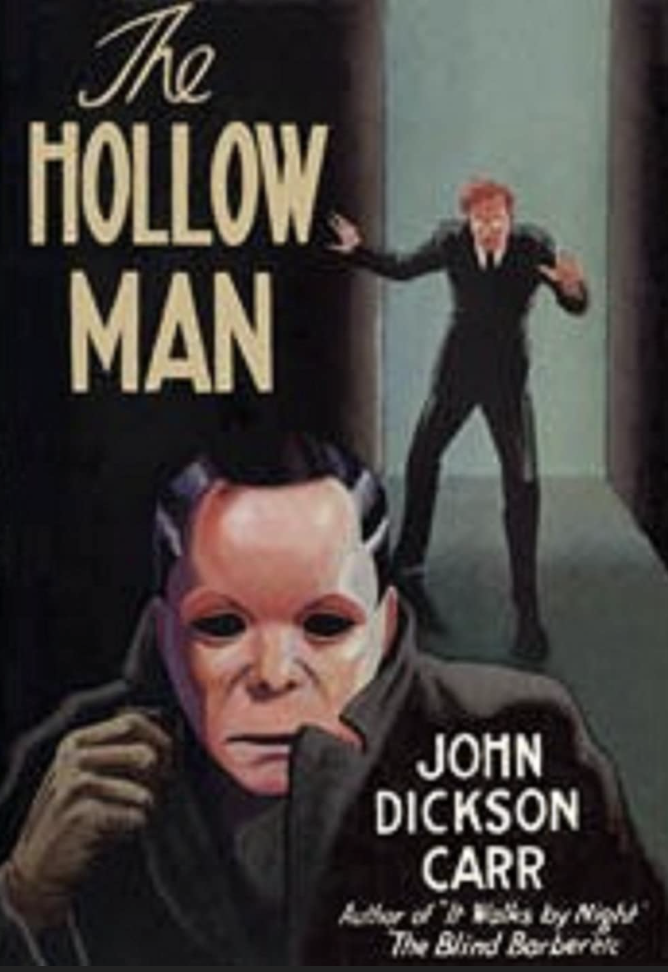
Carr’s most famous novel, The Three Coffins (published in the UK as The Hollow Man), features a “Locked Room Lecture.” Character Dr. Fell describes eight methods that can be used to commit a locked room murder. Within those eight general types are endless variations, which is why the puzzles continue to baffle modern readers and be so much fun.
Benoit Blanc and the town’s police chief Geraldine Scott (Mila Kunis) turn to Carr’s “Locked Room Lecture” to solve the crimes.
Blanc gives his own mini lecture on locked-room methods (just like my character Ivy Youngblood does in my locked-room mystery Under Lock & Skeleton Key), and proves that even if you understand the possibilities, it’s still a challenge to see what’s right in front of you.
Interestingly, the film uses the book’s UK title, The Hollow Man, a nod to the main murder victim of the film. Blanc also refers to the crime as a “locked door” murder, perhaps because it’s easier to understand for a broader audience.
I hope Wake Up Dead Man brings a new generation of readers to John Dickson Carr!
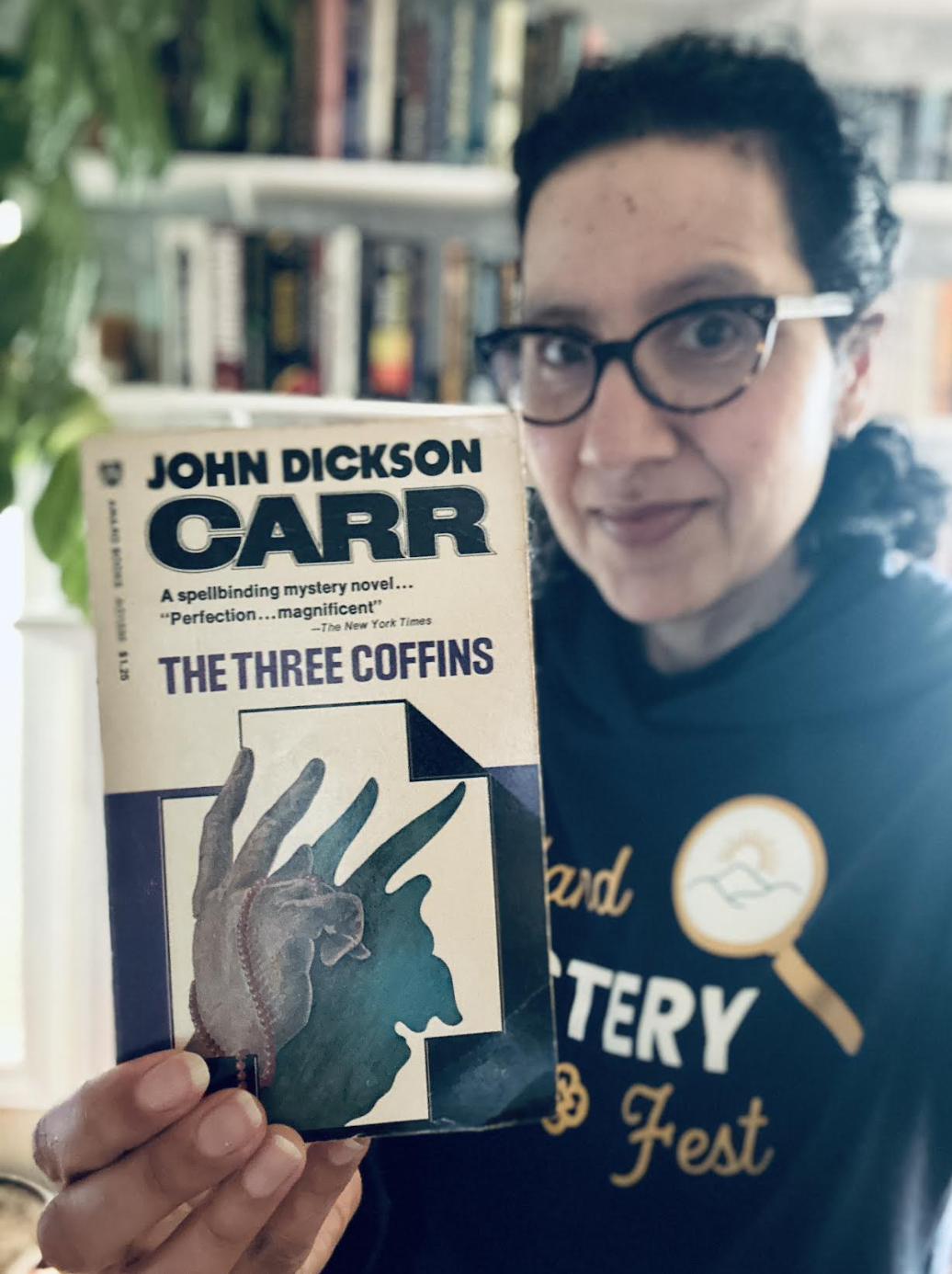
With my beaten-up copy of John Dickson Carr’s The Three Coffins (published as The Hollow Man in the UK).
I’ll end with my favorite part of the movie. When sheriff Geraldine brings up why I continue to be drawn to atmospheric locked-room mysteries: The best locked-room mysteries are Scooby-Doo for adults. As Carr and other authors who write a gothic backdrop into their impossible crime tales do so well, they make us think we’re getting a ghost story—until they unmask the ghost at the end.
After the dead man has risen from his coffin, Sheriff Geraldine says, “There’s some Scooby‑Doo [stuff] going on here,” to which Blanc replies, pitch perfect, “Scooby-dooby-doo!”

When my locked-room mystery Under Lock & Skeleton Key was published in 2022, Publishers Weekly interviewed me on a range of topics including my love of locked-room mysteries. When the feature was published, the title was “Scooby-Doo for Grown-Ups” — a great honor!


